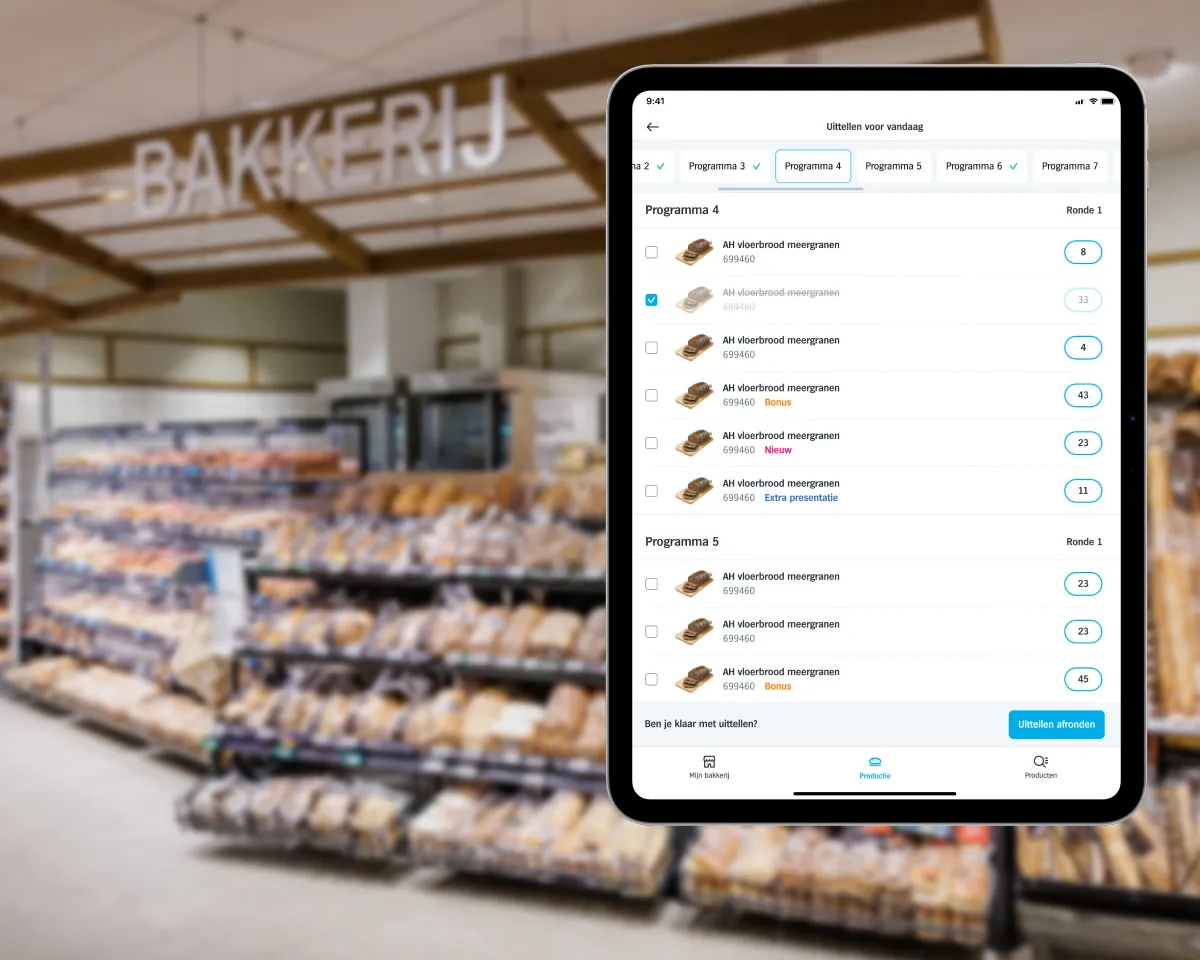
Bak is the iPad app that tells Albert Heijn’s bakery employees how much bread to bake, based on an AI prediction. As a UX designer on the team, I designed features for it during the rollout, and spent time in the bakery with end-users to get them right.
Background
Bread can't be sold the next day, so a wrong prediction means waste or empty shelves. Albert Heijn developed an algorithm to make these predictions, bringing the advice through an iPad app.
My role
I joined later in the project as UX designer to design features during the rollout, and spent time in stores: interviewing, observing and working in the bakery myself.
Result
Customer orders, stock level control in the workflow and instructions in the app, built with the bakery workflow in mind.
The problem
Bread has to sell today
The bakery is one of the hardest departments in a supermarket. Most products can wait: if you have too many, you order a bit less in the coming days. But bread that isn’t sold today is hard to get rid of.
Employees used to predict how much to bake themselves, on paper. Some who had worked there for years got quite good at it, but so much plays a role: the weather, holidays, bonus discounts, a school nearby and whether it’s on vacation, and of course past sales. That’s something an AI model could be much better at than a person.
Albert Heijn built an AI algorithm and a new app around it. I wasn’t the one who set up that app: I joined later in the project and designed features as it rolled out.
Photo: Albert Heijn The challenge
A prediction is only as good as its numbers To decide how much to bake in each of the baking rounds during the day, the algorithm needs to know exactly how much is in the freezer, in production and on the shelf.
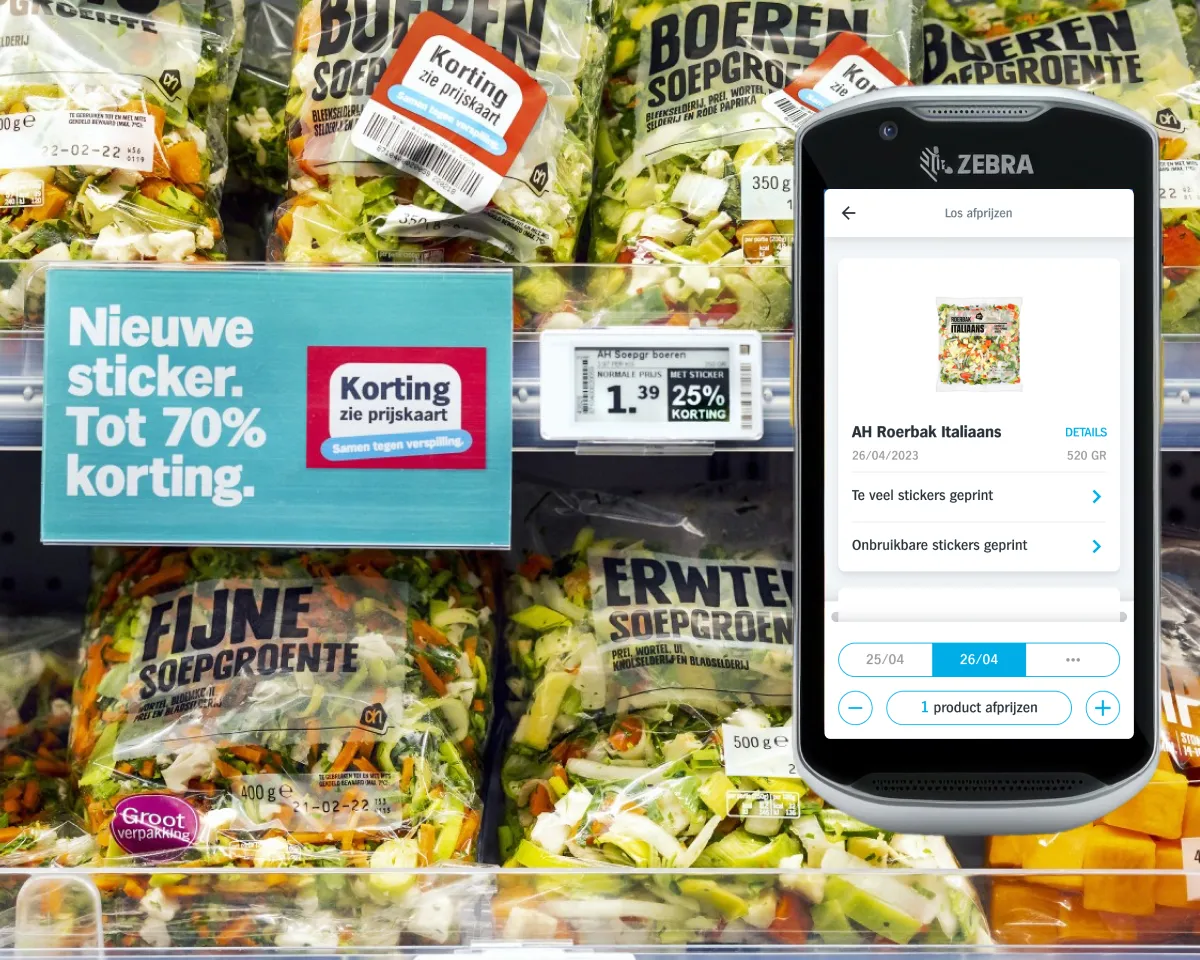
That’s hard in a bakery with six kinds of croissants,4 and many kinds of bread, where customers scan their products themselves. When someone taps the wrong product at the checkout, the stock is off, and the app thinks bread is still on the shelf that isn’t, so no extra baking is triggered.
In the bakery
The best insights come from the store floor, not the office
Insights and inspiration for a bakery don’t come from behind a desk. So I went to stores often, for research and to test ideas: I interviewed bakery employees, observed how they work through the day, and worked in the bakery myself, using the iPad app between the ovens and the freezer.
What I worked on
Features for the rollout
Customer orders
When a customer asks for ten baguettes in two days, employees used to just bake them. Now the app has to know, so those extra products are added to the count-out from the freezer on that day, and the stock levels stay right.
Stock level control
Correcting stock where the work happens Employees can see and change the freezer, production and shelf stock at fixed moments in their workflow, for example when they notice in the freezer that a number is off.
One tool
Borrowing from Wink Wink is the app for all other store processes. We looked at which of its functions we could bring into Bak, so bakery employees don’t have to switch between tools to adjust stock.
Instructions
Explaining the new features There were so many new features that we added an overview of instructions in the app, grouped by category.
The outcome
A small part of a big change
Bak helps bakeries waste less bread, but that’s the result of a large team and years of work on the algorithm. My part was a set of features that helped during the rollout, and a closer look at how people come to accept a new technology.
Reflection
Technology has to earn its place
What I learned How people accept new technology. When software replaces part of people’s own thinking, good numbers alone aren’t enough: people also need to see where the numbers come from, and be able to correct them.
What I would do with more time A bakery is full of ovens, sticker machines, freezers and cutting machines. I would integrate the predictions more into that workflow, instead of putting them on a separate iPad.